Discover how AI agents automate complex business workflows, integrate with systems, and help organizations scale AI with custom AI development solutions.
Enterprise AI is moving beyond chatbots and content generation. AI agents introduce a different capability: the ability to interpret goals, plan actions, interact with business systems, and execute multi-step workflows with limited human intervention.
For organizations looking to automate complex operations, this shift opens up new possibilities. Rather than assisting with individual tasks, AI agents can help coordinate entire business processes.
How AI Agents Work
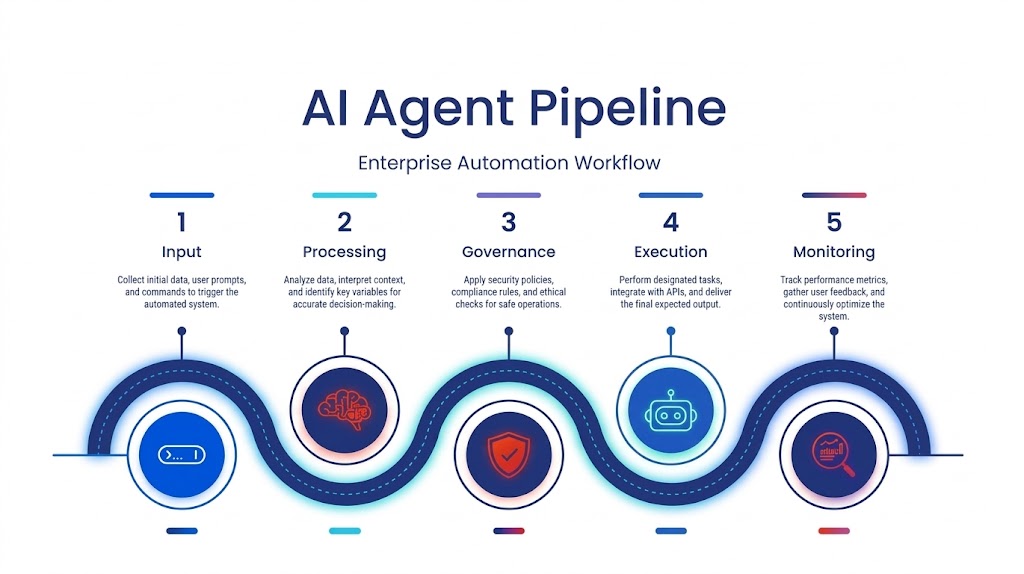
Unlike traditional automation, which follows predefined rules, AI agents can use large language models (LLMs) to interpret requests, determine the next action, and adapt their approach based on the information they receive.
A typical agentic system combines several technical components:
- LLMs and reasoning: Interpret business objectives, break them into subtasks, and determine appropriate actions.
- Tool calling and API integrations: Connect to enterprise systems such as CRMs, ERPs, databases, and document management platforms to retrieve information or execute operations.
- Retrieval-Augmented Generation (RAG): Access relevant internal documents, policies, and knowledge bases to ground decisions in business-specific information.
- Workflow orchestration and memory: Manage task sequences, maintain context, and coordinate multiple agents when a process requires specialized capabilities.
- Guardrails and human oversight: Apply permissions, validation rules, approval checkpoints, and monitoring to ensure actions remain controlled and auditable.
These components enable agents to move from generating recommendations to carrying out approved actions. Their autonomy, however, should be proportional to the task's risk and complexity.
AI Agents in Action: Industry Applications
The value of AI agents becomes clearer when applied to real operational challenges.
Financial services: An agent could collect customer documentation, extract relevant information using Optical Character Recognition (OCR), retrieve verification requirements, and initiate credit assessment workflows. Exceptions or high-risk decisions could be routed to human reviewers.
Manufacturing and supply chain: Agents could monitor inventory levels, evaluate supplier updates, compare replenishment options, and prepare purchase orders when stock falls below predefined thresholds. Approval rules would determine whether an order proceeds automatically.
Healthcare and life sciences: Agents could retrieve clinical documentation, organize information from multiple sources, and support administrative workflows. Access controls and clinical oversight would be essential, particularly where patient data or medical decisions are involved.
IT operations: An agent could investigate a service-desk ticket, retrieve relevant troubleshooting documentation, run authorized diagnostic checks, and resolve routine incidents or escalate unresolved cases.
In each scenario, the objective is to connect intelligence with execution, reducing repetitive coordination while keeping people involved where judgment and accountability matter most.
AI Agents Are Moving Towards Enterprise-Scale Adoption
Enterprise adoption of AI agents is progressing, particularly among larger organizations. According to McKinsey's The State of AI in 2026 survey, 40% of respondents from organizations with annual revenues exceeding $1 billion report scaling AI agents, up from 27% in 2025. Among smaller organizations, the figure remained at 22%.
The trend points to growing investment in AI systems that can execute tasks and workflows, rather than simply generate information. However, scaling these systems requires more than the underlying AI models: reliable data, secure integrations, workflow redesign, and governance are essential to turning agentic AI into measurable business value.
Building on Enterprise AI Foundations
Real-world AI implementations already demonstrate how organizations can automate complex information workflows. For example, Big Blue AI developed a generative AI assistant for Agroknow, using LLMs and RAG to help food scientists access historical food-safety data, research, and regulatory information. In another project, Infrared.city leveraged AI, geospatial data integration, and RAG to automate environmental analysis and sustainability reporting.
These projects illustrate how purpose-built AI can connect fragmented information and streamline specialized business processes, providing relevant foundations for more advanced automation.
Big Blue AI helps organizations translate complex operational needs into tailored AI solutions. Through custom AI development, ML pipelines, enterprise integrations, and bespoke AI architectures, businesses can build systems aligned with their data, workflows, and governance requirements.
Ready to explore how AI agents could transform your operations? Connect with Big Blue AI to discuss a custom AI solution for your business.