Every week, another AI tool promises to transform the way your business works.
A smarter chatbot. A more powerful copilot. An AI agent that can automate your operations.
Before buying the next tool, ask a more fundamental question: Is your data ready for AI?
AI can process enormous amounts of information, identify patterns and generate answers in seconds. Yet fragmented databases, inconsistent definitions and unreliable information remain very real business problems. AI can make the consequences of those problems faster and much harder to spot.
The AI problem that nobody wants to talk about
Many organizations are building AI on top of data that nobody fully owns, understands or trusts.
- Customer information lives across multiple systems.
- Different departments use different definitions for the same KPI.
- Critical processes still depend on spreadsheets.
- Data pipelines break silently.
- And nobody is quite sure which dashboard contains the "real" number.
Put AI on top of this environment and the underlying issues remain.
The financial impact of poor data is significant. Gartner estimates that poor data quality costs organizations an average of $12.9 million per year.
The risks extend beyond inaccurate insights. IBM's 2026 Cost of a Data Breach Report found that more than one in five organizations reported a breach targeting AI models or applications, while AI-enabled attacks accounted for one in four malicious breaches.
Meanwhile, McKinsey's 2025 State of AI research found that nearly two-thirds of organizations have not yet begun scaling AI across the enterprise, and only 39% reported an enterprise-level EBIT impact from AI.
The lesson is clear: buying more AI isn't the same as creating more value from AI.
Foundation first. AI second.
Successful AI initiatives start with the less glamorous work:
- Establishing reliable data pipelines
- Cleaning and validating critical datasets
- Creating common definitions and a single source of truth
- Assigning ownership for important data
- Building appropriate governance
- Developing the skills people need to interpret and use data effectively
This doesn't mean putting AI projects on hold until every dataset is perfect. It means prioritizing the data foundations that matter most to the business and connecting AI investments to clear, measurable use cases.
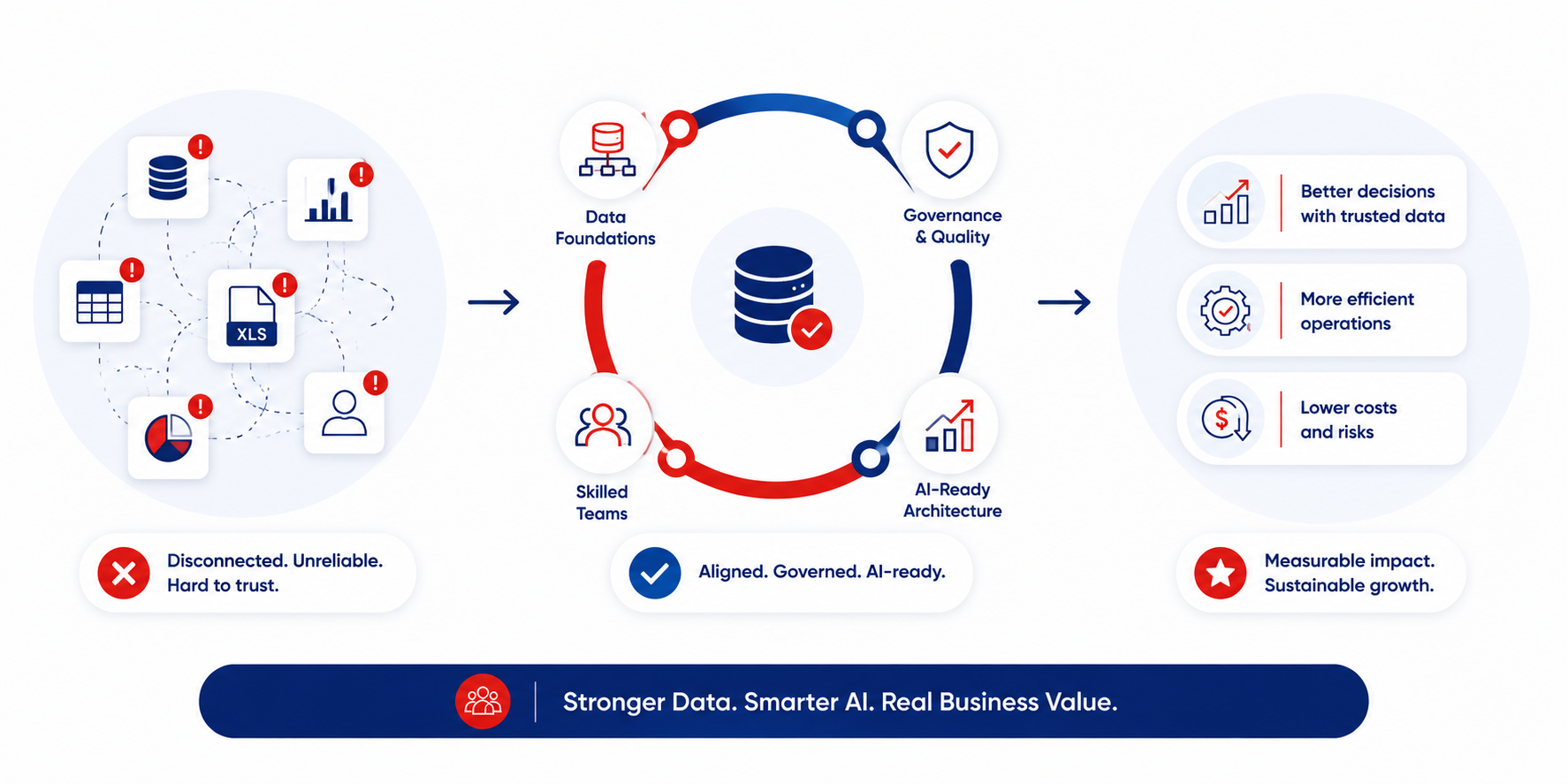
From better data to better AI
Once the gaps become visible, the next question is how to address them without bringing the business to a standstill.
For some organizations, that means rethinking how data is collected and connected. For others, it starts with defining ownership, standardizing key metrics or creating a more reliable data pipeline. In many cases, the technology is already there, the challenge is making the different pieces work together.
This is where the right combination of data expertise and organizational capability becomes important.
A data and AI consulting partner can help map the existing landscape, identify the gaps that are holding AI initiatives back and establish a practical roadmap around the business priorities that matter most. At the same time, internal teams need the knowledge to work with these new capabilities once they are in place.
This combination sits at the heart of Big Blue AI's work. Through its consulting and training services, the company works with organizations on the data foundations behind AI while helping their teams build practical skills in areas such as analytics, Power BI, Python, LLMs and data storytelling. Big Blue AI
The objective is ultimately bigger than implementing another AI solution. It is about creating an environment where people can trust the data, understand the insights and use AI with confidence.
Talk to a Big Blue AI expert and discover what it takes to turn your data into a stronger foundation for AI.