Explore how enterprise LLMs and secure AI architectures help businesses protect sensitive data, maintain privacy, and safely adopt generative AI.
Generative AI is quickly becoming part of everyday business workflows, from document analysis and customer support to software development and internal knowledge management. Yet for organizations handling sensitive information, one question remains critical: What happens to our data when we give it to an AI model?
This concern is particularly important for industries such as healthcare, banking and financial services, legal services, insurance, telecommunications and the public sector, where customer records, financial information, intellectual property and personally identifiable information are part of everyday operations.
Research from McKinsey found that cybersecurity, inaccuracies and personal privacy are among employees' leading concerns about generative AI.
Public AI Tools vs Enterprise LLMs
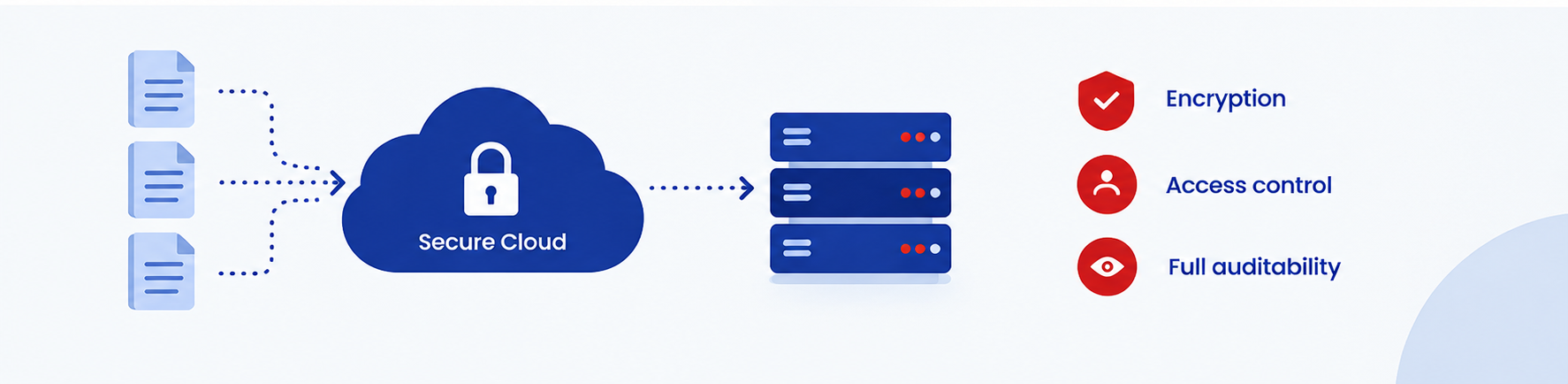
Tools such as ChatGPT provide powerful general-purpose AI capabilities, making them useful for everyday tasks. However, organizations dealing with confidential information need greater control over how data enters, moves through and is accessed by an AI system.
An enterprise LLM environment can be designed specifically around these requirements. Rather than sending sensitive business information into an uncontrolled workflow, companies can deploy models within private cloud environments, isolated infrastructure or secure enterprise architectures.
This gives organizations greater control over:
- Data access: Define exactly which users, systems and applications can access sensitive information.
- Data storage: Establish where prompts, documents and outputs are stored and for how long.
- Encryption: Protect data both in transit and at rest.
- Identity and permissions: Apply existing enterprise authentication and role-based access controls.
- Auditability: Monitor interactions and maintain records of how data is accessed and used.
- Compliance: Design AI workflows around regulatory and industry-specific requirements.
Data governance is particularly important because AI systems can introduce new pathways through which sensitive information is accessed or exposed.
Private Models and Secure AI Architectures
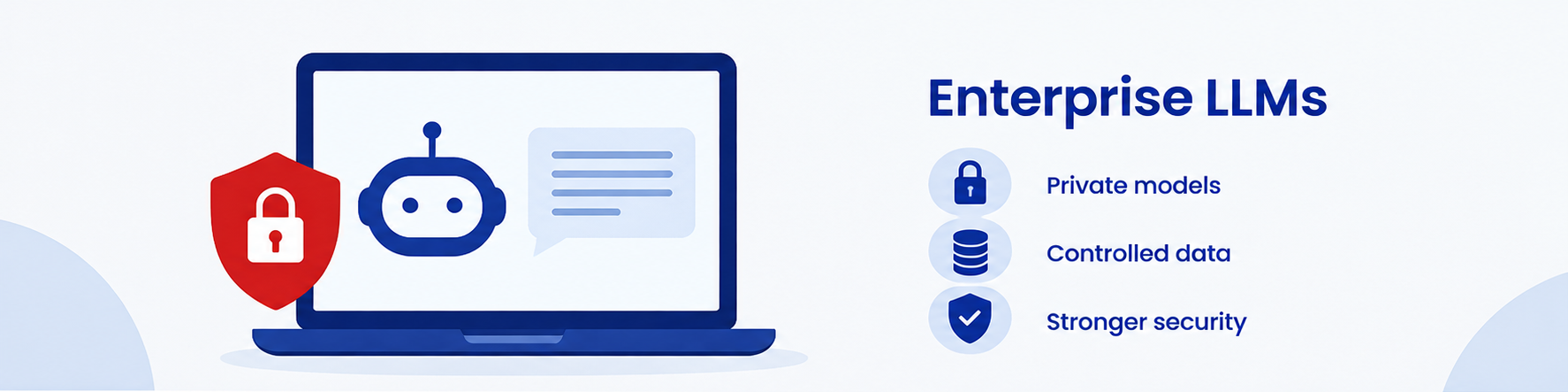
Building a secure enterprise AI solution does not necessarily mean developing an LLM from scratch.
Organizations can use an existing foundation model and create a private AI environment around it. One common approach is Retrieval-Augmented Generation (RAG), where the model retrieves relevant information from an organization's controlled databases or document repositories rather than relying on sensitive information being embedded directly into the model.
For example, a hospital could build an internal AI assistant that retrieves information from authorized medical documentation. A financial institution could connect an LLM to approved internal policies and financial data, while restricting access according to each employee's role.
Additional safeguards can include anonymization, tokenization, encryption, network isolation, access controls and monitoring.
This architecture also creates an important separation between the AI model and the company's data. Sensitive information can remain within the organization's controlled environment while the model provides the intelligence needed to interpret and work with it.
Making AI Useful Without Compromising Trust
For enterprises, data privacy should be considered from the beginning of AI development—not added after deployment. Model selection, infrastructure, data pipelines, access policies and monitoring all need to work together.
The objective is to create AI systems that can work with valuable proprietary information while maintaining the controls required to protect it.
Big Blue AI can help organizations design and develop custom AI solutions built around their specific data, infrastructure and security requirements. From private LLM architectures and RAG systems to tailored AI applications and integrations, the focus is on turning enterprise data into practical AI capabilities while keeping privacy and control at the core.
Contact with a Senior Consultant and explore Big Blue AI's Custom Solutions for Enteprises.